
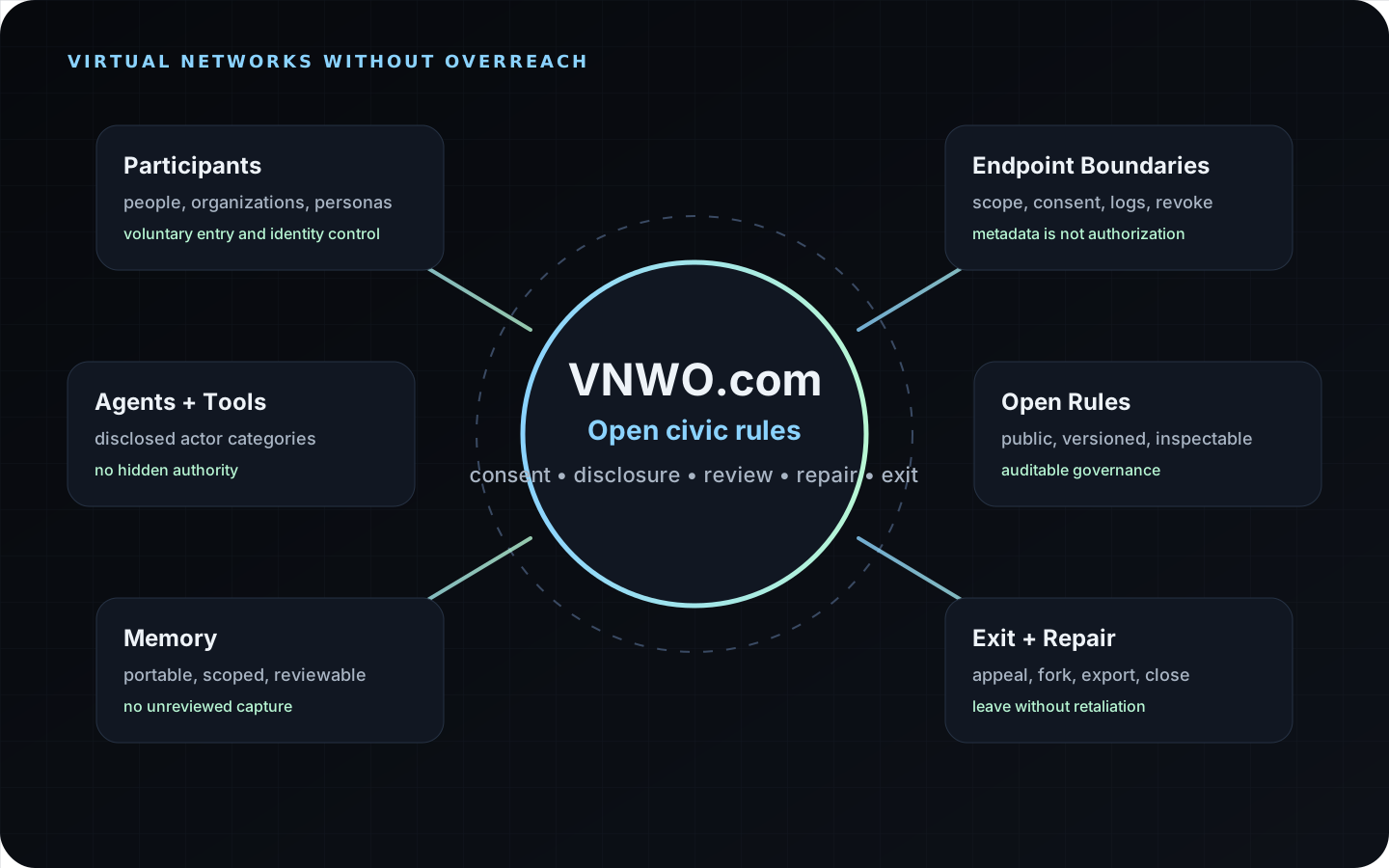
A public endpoint description can help tools discover what might be possible. It cannot, by itself, authorize calls, probing, persistence, delegation, escalation, data extraction, or private inference.
Five distinct endpoint surfaces
Metadata
Public description of what a tool or endpoint can do. Metadata helps discovery; it is not permission.
Consent
Participant or maintainer approval for a specific scope and purpose.
Authorization
The actual system control that permits a bounded action after consent is established.
Logging
Reviewable evidence of endpoint action, denial, error, revocation, or escalation.
Revocation
A documented withdrawal that disables active permission and confirms the result.
Scope
Endpoint access must be bounded by purpose, actor, capability, duration, data category, and revocation path.
- Minimum implementation
- Publish endpoint name, capability description, allowed actions, prohibited actions, and responsible maintainer.
- Evidence to keep
- Endpoint boundary statement, capability metadata, authorization path.
Consent
Consent must be explicit before an endpoint is used, expanded, delegated, or connected to an agent.
- Minimum implementation
- Require affirmative consent before tool calls or access expansion.
- Evidence to keep
- Consent log, scope version, user-visible approval record.
Logging
Endpoint use should leave reviewable records of action, actor, time, scope, result, and error state.
- Minimum implementation
- Log who or what called the endpoint, when, why, and under which authorization.
- Evidence to keep
- Action log, incident log, escalation log, proof-of-review record.
Revocation
Participants must be able to withdraw endpoint access and verify that withdrawal.
- Minimum implementation
- Publish a revocation path and confirm active permissions were disabled.
- Evidence to keep
- Revocation receipt, disabled token record, permission audit.
Local-first caution
Local access can be powerful. Local metadata and local tools are bounded civic surfaces, not ambient permission.
- Minimum implementation
- Treat local endpoints as sensitive even when the metadata is public.
- Evidence to keep
- Local-safe disclosure, no-private-probing note, human approval rule.
Human approval
Sensitive or escalating endpoint actions should require human approval before execution.
- Minimum implementation
- Pause escalation until a human approves the specific action and scope.
- Evidence to keep
- Approval record, reviewer ID or role, UTC timestamp, action summary.
No private probing
Capability discovery must not become covert scanning, data extraction, or inference beyond consent.
- Minimum implementation
- State that discovery is not permission to probe, infer, scrape, or execute.
- Evidence to keep
- Crawler rule, endpoint terms, audit of denied probes.
No hidden persistence
Agents and tools must not persist access channels outside the disclosed scope.
- Minimum implementation
- Disable credentials, cached tokens, or local channels when consent ends.
- Evidence to keep
- Token expiry, credential rotation record, persistence audit.
No escalation without review
Endpoint authority must not expand silently. Escalation requires review and renewed consent.
- Minimum implementation
- Define escalation triggers and require renewed approval before broader access.
- Evidence to keep
- Escalation policy, reviewer log, renewed consent record.
Least privilege and zero-trust posture
VNWO endpoint boundaries borrow a simple security lesson: discovery should not create ambient trust. Every endpoint action should be mediated by purpose, actor, capability, duration, environment, and revocation path. If scope changes, renewed consent or human approval should be required.
Least privilege
Grant only the smallest capability needed for the stated purpose, and record the reason in a reviewable boundary statement.
Complete mediation
Every sensitive call should evaluate current authorization, not rely on an old discovery record or stale token.
Endpoint refusal codes
A refusal code lets a tool deny overbroad requests without pretending that VNWO authorizes or executes endpoint behavior. The implementation remains local to the builder.
| Code | Meaning |
|---|---|
UNKNOWN_CAPABILITY | Requested action is not listed in public capability metadata. |
NO_AUTHORIZATION | Capability may exist, but the requester has no valid authorization grant. |
SCOPE_EXCEEDED | Request expands purpose, actor, data category, duration, or environment beyond approved scope. |
CONSENT_REQUIRED | No valid consent record exists for this action. |
RENEWED_CONSENT_REQUIRED | Prior consent exists but scope, risk, actor, or context has materially changed. |
HUMAN_APPROVAL_REQUIRED | Action is sensitive or escalating and must pause for human review. |
REVOKED | Previously granted authority has been withdrawn. |
PRIVATE_PROBING_BLOCKED | Discovery or request pattern appears to probe beyond published metadata. |
HIDDEN_PERSISTENCE_BLOCKED | Request would create undisclosed persistence, cached authority, or background access. |
CLAIM_BOUNDARY_BLOCKED | Request depends on a claim VNWO does not support, such as certification, legal authority, or runtime control. |
Copy-safe endpoint boundary language
Public capability metadata is not authorization. This endpoint may be discovered publicly, but any use requires scoped consent, authorization by the implementing system, reviewable logs, a revocation path, and human approval for escalation. Discovery is not permission to probe, persist, extract, or widen access.